

Splice Sealing Decision Guide: Dual-Wall Heat Shrink vs BluSeal vs Ultra Water Barrier
Splice Sealing Decision Guide: Dual-Wall Heat Shrink vs BluSeal vs Ultra Water Barrier
Splice sealing fails when a program defaults to “always dual-wall heat shrink” without naming the failure mode, the process constraint, or the geometry. Exterior adhesive-lined tubing seals the outside of a conventional splice well—but strand-level capillary wicking, longitudinal water tracking at battery terminals or firewalls, and high wire-count irregular junctions still produce corrosion and rework when the wrong method is locked in.
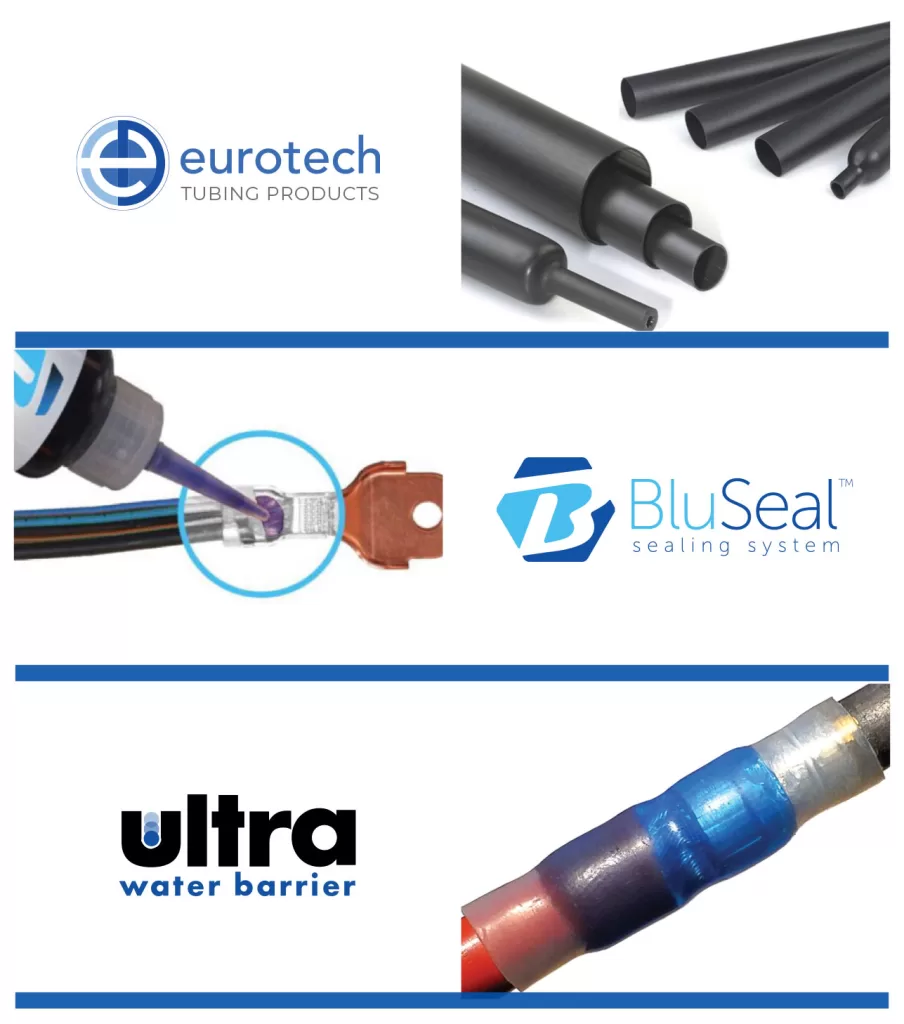
This splice sealing decision guide maps three Eurotech Direct methods side by side: dual-wall (adhesive-lined) heat shrink tubing (HST), BluSeal strand-level liquid seal, and Ultra Water Barrier (UWB) acrylic mastic with HST encapsulation. It is for harness process engineers, OEM splice / EDS owners, quality and reliability teams, and plant manufacturing engineers choosing a sealing method. Product details are on the Eurotech sealing solutions hub.
Why one splice seal fails modern harnesses (geometry, capillary paths, and plant process)
Three failure patterns show up repeatedly on drawings and line trials:
- Exterior-only seal where strands still wick — dual-wall HST recovers and adhesive flows around the splice exterior, yet contaminated water can still enter via capillary action between conductors and under the insulating jacket, especially on high wire-count or irregular constructions.
- Longitudinal migration under an otherwise good HST seal — adhesive-lined tubing seals the outside; water can still track along strands into battery terminals, engine-compartment junctions, or firewall passthroughs.
- Process mismatch — heat guns, ovens, or specialized HST machines require CAPEX, floorspace, and energy; BluSeal dip/drip automation may be a better fit when strand penetration is the real need and controlled liquid application is available on the line.
Eurotech’s sealing stack is built for those distinctions: dual-wall HST for exterior environmental splice seals, BluSeal for strand penetration, and UWB when the problem is longitudinal water block. For North America buyers, Eurotech offers the full method stack—plus an HST splice calculator, HST sticks and sample kits, BluSeal dip/drip equipment, and engineering contact—on one site.
Three sealing methods at a glance (chooser matrix)
Start with three decision questions, then compare methods
- Is the primary risk exterior moisture/fluids at a conventional splice, or strand-level / longitudinal tracking?
- Is controlled heat recovery available and preferred for tubing encapsulation—or is liquid strand sealing (BluSeal dip/drip) the better process fit?
- Is the splice high wire count / irregular, needing a strand penetrant—or is the problem battery terminal / firewall passthrough longitudinal migration?
Dual-wall (adhesive-lined) HST
- What it seals
- Exterior of splice/termination: insulation, abrasion, environmental moisture/fluids via melted adhesive barrier
- Heat required?
- Yes — controlled heat recovery
- Best-fit geometry / use case
- Conventional in-line splices, ring terminals, lug transitions where exterior seal is the dominant need
- Typical secondary needs
- Correct IDe/IDr and shrink ratio; balanced splice CSA
BluSeal strand-level seal
- What it seals
- Strand-level / under-jacket paths: capillary and pressure-differential ingress between conductors
- Heat required?
- No for the liquid — HST heat only if used as secondary insulator
- Best-fit geometry / use case
- High wire-count junctions; construction variance; irregular splices where exterior encapsulation alone is incomplete
- Typical secondary needs
- Normally electrical tape or HST as secondary insulator
Ultra Water Barrier (UWB)
- What it seals
- Longitudinal water migration at terminals / between leads (battery cables, firewall passthroughs)
- Heat required?
- Yes — HST encapsulates the mastic strip
- Best-fit geometry / use case
- Unsealed battery terminals in the engine compartment; firewall harness water block; road-fluid exposure
- Typical secondary needs
- Acrylic mastic + HST encapsulation as a system
Three splice sealing methods — dual-wall HST, BluSeal, and UWB. Compare on failure mode, heat/process fit, and geometry before locking a drawing callout.
Dual-wall adhesive-lined heat shrink — when the exterior seal is the right call
What dual-wall does (and single-wall does not)
Per Eurotech’s heat shrink guidance, single-wall tubing primarily provides insulation and abrasion protection. Dual-wall (adhesive-lined) tubing adds an inner adhesive layer that melts and flows during recovery to form a waterproof, corrosion-resistant barrier around the splice or termination exterior. That is the right call when the dominant risk is environmental moisture, salt, or road fluids at a conventional splice, ring terminal, or lug transition—not when strand capillary paths or longitudinal tracking under the jacket are already the documented failure mode.
Eurotech supplies single-wall and dual-wall automotive heat shrink with shrink ratios including 2:1, 3:1, and 4:1, plus caps, custom, and clear/transparent options. Eurotech lists approvals for the product line from Ford, General Motors, and Stellantis (and more), and per the HST page it is manufactured under quality systems including IATF 16949 and ISO 9001 and produced to meet or exceed UL224 and MIL approval requirements. Contact sales for program-specific documentation rather than assuming a published brand list covers every SKU.
Eurotech also publishes recommended replacements for named TE / Raychem families (for example, ET25 or ET82 versus ES-2000 or RBK; ET86 versus FL2500; ET84 CAP versus ES-CAP; ET87 versus SCT). These are Eurotech recommendations, not independent certified cross-references, unless your program package confirms equivalence.

Sizing and splice design
Use the HST Splice Calculator rather than improvising cutoffs. Enter wire insulator ODs; the tool sums OD², applies a packing factor, and reports bundle diameters with ±10% windows. Selection rules of thumb published with the calculator:
- Select an expanded ID (IDe) larger than the largest side by at least about +10%.
- Select a recovered ID (IDr) smaller than the smallest side by at least about 10%.
- Prefer balanced cross-sectional area on each side of the splice when possible.
- Shrink-ratio bands from the calculator: 1.00–0.50 → 2:1; 0.49–0.33 → 3:1; 0.32–0.24 → 4:1; below 0.24 → greater than 4:1.
Example SKU families called out on Eurotech HST tools and pages include dual-wall options such as ET82 (4:1) and ET25 (+125°C class), and single-wall ET70 (+135°C class)—confirm the datasheet for the exact drawing callout.

Process notes
Recover with controlled temperature and time using heat guns, ovens, or specialized HST processing equipment—not open flame. Avoid overheating that can char the jacket or cause adhesive drip. For tubing trials, Eurotech offers HST Sticks & Sample Kits (for example ET81 and ET70 sample kits) for heat shrink evaluation.
BluSeal — strand-level sealing for high-count and irregular splices
Mechanism
BluSeal is a very low-viscosity automotive-grade liquid sealer applied by drip or dip. It penetrates between each wire strand and deep under the insulating jacket, then cures to a durable, semi-flexible acrylic polymer barrier. Eurotech’s BluSeal tech data describes the problem as contaminated water ingression driven by capillary action and pressure differentials from temperature change—failure modes that exterior-only encapsulation does not fully address. SAE paper 2024-01-2356 discusses the BluSeal sealing mechanism in technical detail; confirm OEM approvals separately with Eurotech.
Important process fact: BluSeal is normally used with a secondary insulator such as electrical tape or heat shrink tubing. BluSeal seals at the strand level; the secondary insulator still provides exterior insulation and mechanical cover.

When BluSeal fits
- High wire-count junctions where exterior HST or enclosures leave strand paths open.
- Construction variance and irregular splice geometries that defeat a neat adhesive sleeve seal.
- Eyelet, one-sided, and two-sided splices where capillary risk is called out in validation or warranty.

Eurotech supports controlled application with the BluSeal Dip Machine (BDM) for splices and the BluSeal Precision Drip Machine (BPDM)—a precise dispenser with a 3-axis applicator—for high-volume terminal sealing. Shop bottles listed on the BluSeal page: ET008-50 (50 g) and ET008-500 (500 g). BluSeal tech data cites a post-cure operating temperature range of approximately −40°C to 125°C; cure of an optimal film can range from seconds to minutes depending on atmosphere, with humidity, moderate convection heat, or HST application able to accelerate cure. Validate production cycle times on your line with Eurotech process support.
Ultra Water Barrier (UWB) — longitudinal water block at battery terminals and firewalls
Mechanism
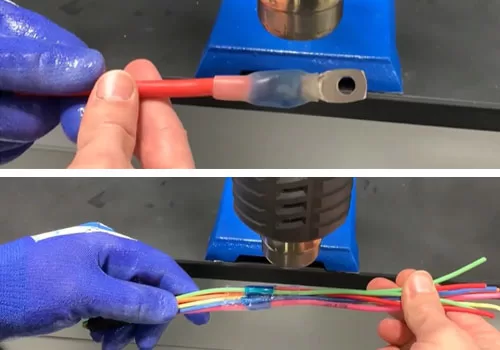
Ultra Water Barrier (UWB) is a translucent blue acrylic mastic encapsulated with heat shrink tubing. On battery cables, mastic is applied at terminal and insulator junctions to the conductors; HST then protects the mastic strip. On firewall / harness applications, mastic is embedded between cable leads to form a longitudinal barrier against fluids and moisture, again encapsulated with HST. Eurotech positions UWB for OEM, aftermarket, and retrofit needs, with flexibility without leaks and protection from road fluids and contaminants.
The HST splice calculator page makes the complementary point explicit: adhesive-lined tubing seals the outside; water can still track longitudinally along strands. UWB under HST is the Eurotech answer when that longitudinal path is the failure mode—not “more dual-wall” alone.
When UWB fits versus more dual-wall
- Previously unsealed battery terminals inside the engine compartment.
- Wire harnesses passing through automobile firewalls where longitudinal water blocking is required.
- Round-crimped or flat-welded cable terminal constructions called out on the UWB page.
Supporting media: UWB webinar. Eurotech positions UWB as a premium option versus other market solutions—validate performance on your application with Eurotech.
How to choose — splice sealing decision guide path
- Name the failure mode. Exterior moisture/fluids at a conventional splice → start with dual-wall HST. Strand capillary / under-jacket ingress on high-count or irregular splices → BluSeal (+ secondary insulator). Longitudinal migration at battery terminals or firewalls → UWB + HST.
- Check process constraints. Is controlled heat recovery available (guns, ovens, or specialized HST machines)? If tubing is in the stack, plan recovery carefully. If strand sealing is the need, ask whether BluSeal dip/drip automation (BDM / BPDM) fits the station better than relying on exterior encapsulation alone.
- Check geometry. Wire count, splice balance, terminal type (eyelet, one-sided, two-sided, battery lug), passthrough.
- Pick the primary method and note secondaries. BluSeal normally needs tape or HST cover. UWB is a mastic + HST system. Dual-wall HST stands alone for exterior seal when sized correctly.
- Size and evaluate. Run the HST splice calculator whenever tubing is in the stack. Order HST sticks or sample kits for tubing trials. Contact Eurotech for BluSeal or UWB program support and process validation.
Coroplast Tape and Coroflex HV cable are Eurotech partners for adjacent protection and electrification systems—not competitors to this sealing chooser.
FAQs
When is dual-wall (adhesive-lined) heat shrink enough for a waterproof splice?
When the dominant need is an exterior environmental seal on a conventional splice or termination—and strand-level capillary tracking or longitudinal migration is not the documented failure mode. Single-wall covers insulation/abrasion; dual-wall adds the adhesive moisture barrier. Confirm sizing with the HST splice calculator.
What is the difference between an exterior HST seal and BluSeal strand-level sealing?
Dual-wall HST adhesive encapsulates the outside of the splice. BluSeal wicks between strands and under the jacket, curing to a semi-flexible acrylic barrier. They address different water paths; many programs combine BluSeal with a secondary insulator (tape or HST).
Do I still need heat shrink or tape if I use BluSeal?
Normally yes. BluSeal tech data states it is used in conjunction with electrical tape or heat shrink tubing as a secondary insulator.
How do plant heat and BluSeal process options affect the choice?
Dual-wall HST and UWB both require controlled heat recovery for tubing. BluSeal’s liquid itself does not need heat to seal strands; humidity, moderate convection heat, or HST can accelerate cure, and a secondary insulator (tape or HST) is normally still required. If heat recovery capacity is constrained, ask whether strand sealing with BluSeal dip/drip automation fits the failure mode—do not assume exterior tubing alone will close capillary paths.
What problem does Ultra Water Barrier solve that dual-wall HST alone may not?
Longitudinal water migration—for example at unsealed battery terminals in the engine compartment or through firewall passthroughs. UWB places acrylic mastic at the critical junctions or between leads and encapsulates it with HST.
How do I size adhesive-lined tubing for a multi-wire splice?
Use the HST Splice Calculator: enter lead ODs, review OD² sum and packing, then select IDe/IDr within about ±10% of the largest/smallest sides and the matching shrink-ratio band. Design balanced CSA when possible.
Which OEMs have approved Eurotech heat shrink?
Eurotech lists approvals from Ford, General Motors, and Stellantis (and more). Contact Eurotech for program-specific documentation. Ask Eurotech for the documentation package that applies to your SKU and program.
Can I get heat shrink samples?
Yes—Eurotech’s HST Sticks & Sample Kits category (examples include ET81 and ET70 sample kits) is for heat shrink evaluation.
Next step — contact, product pages, HST calculator and kits
Share splice geometry, wire count, heat-process constraints, and whether the risk is exterior moisture, strand wicking, or longitudinal migration. Eurotech sales engineers will map dual-wall HST, BluSeal, or UWB to your application.
- Talk to Eurotech: Contact Eurotech Direct — +1.330.467.0205 | [email protected] | 5145 Brecksville Rd Ste 101, Richfield, OH 44286 | Mon–Fri 8:00AM–5:00PM
- Sealing hub: Wire harness sealing solutions
- Method pages: Heat shrink tubing · BluSeal · Ultra Water Barrier
- HST tools: HST Splice Calculator · HST Sticks & Sample Kits
